Future Self Script: How to Write the Words Your Future Self Would Say
Learn how to write a future self script that turns reflection into identity rehearsal, daily action, and personalized future-self audio practice.

A future self script is a written or spoken identity rehearsal that describes how the person you are becoming thinks, feels, chooses, and acts. Unlike a generic affirmation, a strong future self script is specific, emotionally believable, and connected to real daily action. You can read it, speak it, record it, or turn it into personalized audio for daily practice.
Most people know what they want to change, but they do not always know what to say to themselves when the old pattern shows up. The argument with a partner. The familiar self-doubt before a meeting. The late-night scroll instead of the work that matters. In those moments, you do not need another goal — you need a line to return to. A future self script gives your mind that line. It is the written, spoken version of who you are practicing being, in the specific, ordinary moments where the old pattern usually wins. You are the person you practice being. Your future self is not a fantasy. It is a direction. And a future self script is one of the most practical ways to keep walking it. This guide is about writing yours — and turning it into something you can actually use, including personalized [future self audio](/create-audio) you listen to as part of daily life.
What Is a Future Self Script?
A future self script is a short, present-tense piece of writing — usually a paragraph to a page — spoken in the voice of the version of you you are becoming. Unlike a future self letter, which is often a one-time time capsule, a script is built to be returned to. You read it, speak it, record it, or listen to it. It is identity rehearsal you can hold in your hand.
You may see this practice called manifestation scripting, a self-concept script, or a future self affirmation script. The frame we use at FutureSelfAudio is simpler: a script is the language your future self uses, in the moments that matter most. It is not about predicting the future. It is about practicing the identity that will create it.
If you want the broader practice this fits inside, read our guide to identity rehearsal and our overview of how to connect with your future self.
Why a Future Self Script Works
Your mind is already running scripts. Old narratives about what you can and cannot do, how you handle stress, what you are allowed to want. They feel natural only because they are highly practiced. A future self script gives you a different line to return to — one that is chosen, specific, and tied to action.
Reading and listening to a clear script repeatedly helps this new state feel more familiar. It gives you a consistent reference point for the identity you are practicing, so when the old pattern shows up, you have something to reach for. If your attention wanders to your inbox or your grocery list halfway through, that is normal. The practice is the gentle return, not the perfect focus.
The FutureSelfAudio Script Method
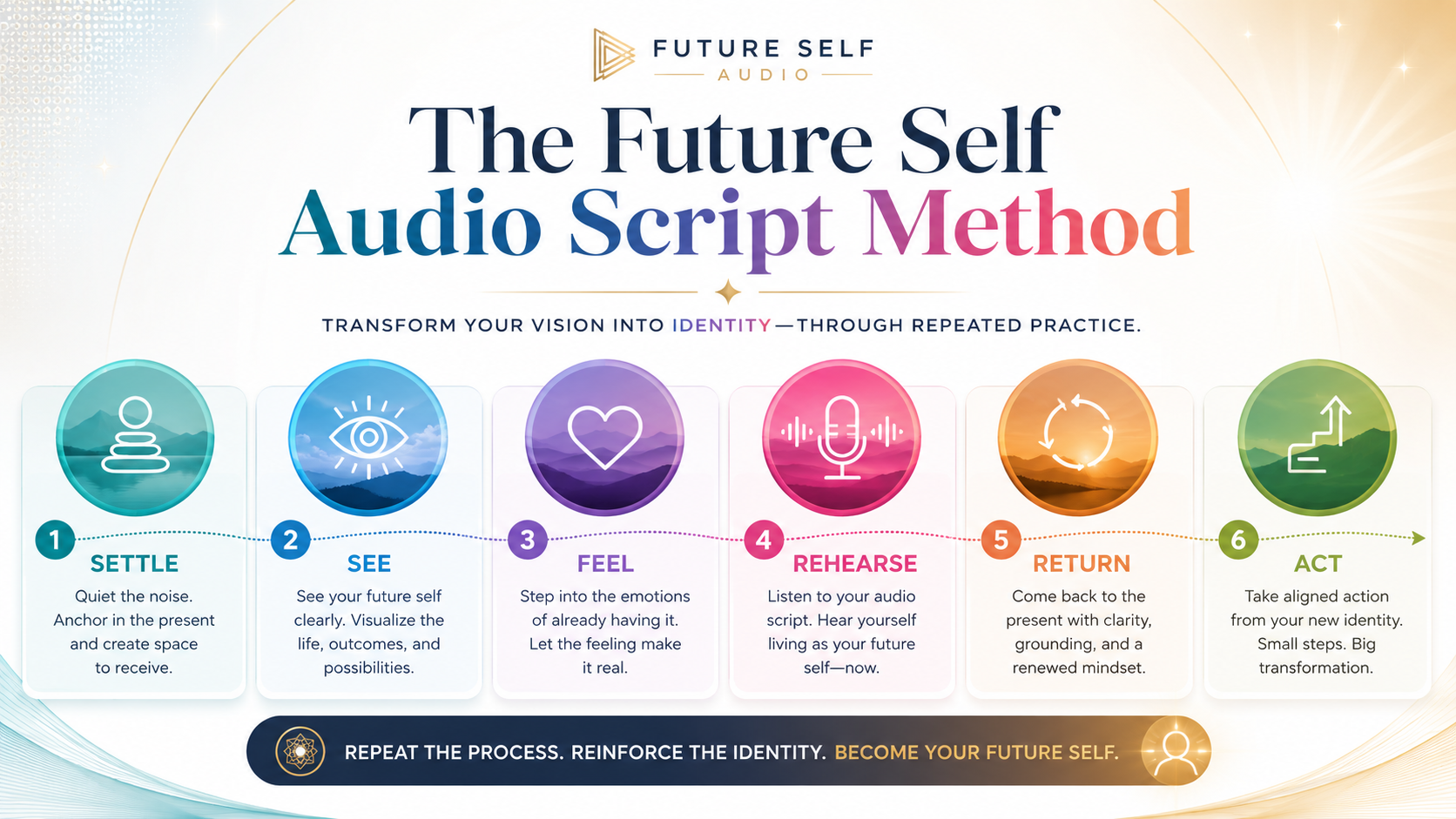
The FutureSelfAudio Script Method is our simple inner rehearsal framework for moving from a blank page to a script you will actually use. It has six steps: **See → Name → Feel → Speak → Repeat → Act.**
**1. See.** Picture the version of yourself you are becoming in a real, ordinary moment — not a highlight reel. Sitting at your desk. Walking through your front door. Opening a difficult message. Specific scenes give your mind something to rehearse.
**2. Name.** Identify the old pattern that usually runs in that moment, and the new identity you are choosing instead. Naming both gives the script something to replace, not just something to add.
**3. Feel.** Connect the script to a body state or emotional state. Calm shoulders. A warm chest. Steady breath. A clear head. Without the felt state, the words stay theory.
**4. Speak.** Write in first person, present tense, using words you would actually say out loud. If a line sounds like a marketing slogan, it is not yours yet.
**5. Repeat.** Return to the same script long enough for the new identity to feel familiar. Most people need at least a week with the same words before they start to land.
**6. Act.** Pair the script with one small, aligned action in real life — sending the message, starting the work, taking the walk. Action is what makes the rehearsal real.
Want a Personalized Starter Script?
If you would rather not start from a blank page, you do not have to. Answer a few reflective questions and receive a personalized message from your future self, plus a practice script and 7-day challenge you can use immediately.
How to Write Your First Future Self Script, Step by Step
You do not need to be a writer. You need a few quiet minutes, a notebook or a notes app, and a willingness to be honest. Here is the process.
### 1. Choose your timeframe and one scene Pick a point in the future — six months, a year, three years. Then choose a single, ordinary scene from that timeline. Where are you? What time of day is it? What are you about to do?
### 2. Write in first person, present tense Use "I am," "I feel," "I notice," "I choose." Avoid "I will" and "I want" — they quietly confirm that you do not have it yet. Present tense is what makes it rehearsal instead of longing.
### 3. Focus on your internal state External details (the office, the home, the income) are fine, but the real material is internal. How do you respond when things go wrong? How do you feel when you wake up? Instead of "I have a million dollars," try, "I feel steady when I look at my finances, and I trust myself to make clear decisions with what I have."
### 4. Keep it grounded and believable If a line sounds like a sales pitch, your mind will quietly reject it. Write in your natural voice. Believable beats impressive every time. If you want to warm up before drafting, use our future self journaling prompts to clarify what you actually want to practice.
Future Self Script Template
If you want a starting structure, use this fill-in-the-blank template. Keep your answers specific, believable, and tied to one real-life moment.
> Today, I am practicing being the version of myself who ______. > I release the old pattern of ______. > I choose to feel ______ in my body. > When ______ happens, I respond by ______. > I remind myself: ______. > Today, I prove this identity through one action: ______.
This template works best when the blanks are specific, believable, and connected to one real-life moment — not your whole life at once.
Five Grounded Future Self Script Examples
Use these as starting points, not as scripts to copy. The words only work when they sound like you.
### 1. Confidence script > "It is 8:30 on a Tuesday and I am at my desk with a warm cup of tea. I look at today's calendar and feel a quiet readiness instead of that old flutter of anxiety. I know my work and I trust my voice. In meetings today, I speak clearly and let my point land without over-explaining. I am here to contribute, not to perform."
### 2. Money and abundance script > "I sit down to look at my finances and my shoulders stay soft. I see the numbers as they are, without panic and without pretending. I make one clear, useful decision today — a saved dollar, a paid bill, a sent invoice — and I let that be enough. I am building a steady relationship with money, one honest choice at a time."
### 3. Love and relationship script > "When my partner says something that used to set me off, I notice the heat rise and I breathe before I respond. I stay on my side of the conversation. I can disagree without disappearing or attacking. I choose connection over being right, and I trust myself to say what I actually mean."
### 4. Discipline and focus script > "It is morning and I open the work that matters most before I open anything else. I keep my phone in the other room for the first hour. When the urge to switch tabs arrives, I notice it and stay. I am the kind of person who finishes the hard thing first, and the rest of the day follows from that."
### 5. Purpose and creative work script > "I sit down to create and I let the first draft be ugly. I trust that showing up is the work, and the quality follows the showing up. I do not wait to feel ready. I am someone who makes the thing, shares it, and learns from what comes back. My voice gets clearer the more I use it."
Common Mistakes That Make a Future Self Script Feel Fake
If your script is not landing, it is usually one of these — and all of them are normal. Adjust and keep going.
- **Making it too vague.** "I am happy and successful" gives your mind nothing to rehearse. Name the scene, the feeling, and the action. - **Writing fantasy instead of identity.** A script about a perfect, problem-free life sounds like fiction. A script about how you handle ordinary life from a steadier place sounds like you. - **Copying someone else's words.** Borrowed language stays borrowed. Edit until the lines sound like something you would actually say out loud. - **Using language that feels fake to you.** If a phrase makes you cringe, your mind is telling you the truth. Find a softer, more honest version. - **Skipping the emotional state.** Words without a felt sense stay in your head. Anchor each line to a body state — calm, steady, warm, awake. - **Not pairing the script with action.** Reading alone is not enough. One small aligned action is what tells your mind this identity is real. - **Changing the script every day.** A script needs repetition to land. Stay with the same words for at least a week before you revise.
How to Turn Your Future Self Script Into Audio
A written script is powerful. A spoken one, in your own voice or a voice that sounds like the you you are becoming, is harder to ignore. Your written script becomes the source code for your personalized future-self audio.
1. **Read it slowly out loud.** Notice which lines you stumble on — those are the ones to revise. 2. **Record it in your own voice.** A phone voice memo is enough. Hearing yourself speak the identity is part of the practice. 3. **Add simple breath cues.** Two or three slow breaths at the start, one between sections. Many people find it adds emotional resonance. 4. **Listen before one aligned action.** A meeting, a conversation, a workout, a hard email. Pair the audio with the moment it is for. 5. **Repeat for at least seven days.** Same script. Same time. This can make the pattern easier to return to. 6. **Revise only after testing.** Edit after a week of practice, not after a hard day. 7. **Use personalized audio when you want it more immersive.** When you are ready for a deeper, produced version, create your personalized future-self audio from your script.
A Simple 7-Day Future Self Script Challenge
If you want a structure for the first week, use this. One small thing per day.
- **Day 1.** Write the first script using the template above. - **Day 2.** Read it out loud, slowly, once in the morning and once at night. - **Day 3.** Record it as a voice memo in your own voice. - **Day 4.** Listen to it once before one aligned action — a meeting, a workout, a hard conversation. - **Day 5.** Revise one line to make it more believable. Just one. - **Day 6.** Use the script — silently or out loud — during a real moment where the old pattern usually wins. - **Day 7.** Reflect, then choose the next identity to rehearse.
### Reflection prompts for Day 7 - What line felt most true? - What line felt hardest to believe? - Where did I act more like my future self? - What action became easier? - What do I want to repeat next week?
In closing
A future self script is not a one-time spell. It is a small, repeatable practice that gives your mind a clearer line to return to when the old pattern shows up. Write it specific. Speak it slowly. Listen to it often. Pair it with one real action. Then revise. When you are ready to take this off the page, [get a personalized future self message](/tools/future-self-message) to use as your starter script, or [create your personalized future-self audio](/create-audio) from the script you already have. For more practices that pair beautifully with scripting, explore our [future self journaling prompts](/learn/future-self-journaling-prompts), our guide to [future self meditation](/learn/future-self-meditation), and the full [Learn library](/learn). You are the person you practice being. Today's script is one more rep.

Ready to stop only thinking about your future self and start rehearsing them?
Try a personalized FutureSelfAudio practice and begin building the inner familiarity that supports real-world action.
FAQ
- What is a future self script?
- A future self script is a short, present-tense piece of writing spoken in the voice of the version of you you are becoming. It describes how that person thinks, feels, chooses, and acts in specific, ordinary moments. You read it, speak it, record it, or turn it into personalized audio for daily identity rehearsal.
- What is the difference between a future self script and a future self letter?
- A future self script is written in the present tense from the perspective of your future self ("I am calm and focused"), and is built to be returned to daily as identity rehearsal. A future self letter is usually written once to your future self ("I hope you have done X by then"), more like a time capsule than a daily practice tool.
- How long should a future self script be?
- Your script does not need to be long. A focused paragraph of 100–150 words can be enough if it captures a specific feeling, real-life scene, and aligned action. Many people prefer 200–500 words for a more immersive audio practice.
- Should I write my future self script in the present or future tense?
- Write in the present tense — "I am," "I feel," "I notice," "I choose." Present tense turns the script into rehearsal instead of longing, and helps the identity feel more familiar over time.
- How far into the future should my script be set?
- Six months to one year is a good default. That window is far enough for meaningful growth and close enough for your mind to treat the identity as realistic and relevant to today.
- What should I do if my future self script feels unrealistic or fake?
- Usually the goals are too extreme or the language is too polished. Ground the script in ordinary moments, use your natural voice, and focus on how you want to respond to normal challenges rather than describing a perfect life.
- How often should I read or listen to my future self script?
- Daily, ideally at the same time — first thing in the morning, before bed, or right before one aligned action. Consistent repetition is what helps the identity feel more familiar.
- Can I record my own voice reading my future self script?
- Yes — a phone voice memo is enough to begin. Hearing yourself speak the identity in your own voice is part of the practice. When you want a more immersive, produced version, you can create personalized future-self audio from your written script.
- How often should I update my future self script?
- Stay with the same script for at least a week before revising, then review it every three to six months or when your goals or circumstances meaningfully shift. Your script should reflect the identity you currently want to practice.
Start rehearsing your future self this week.
Get the future-self scripting worksheet, a self-hypnosis script template, a sleep affirmation prompt sheet, and a simple 7-day listening routine.
Rehearse the person you're becoming.
Turn your goals, affirmations, and visualizations into personalized future-self audio in minutes.